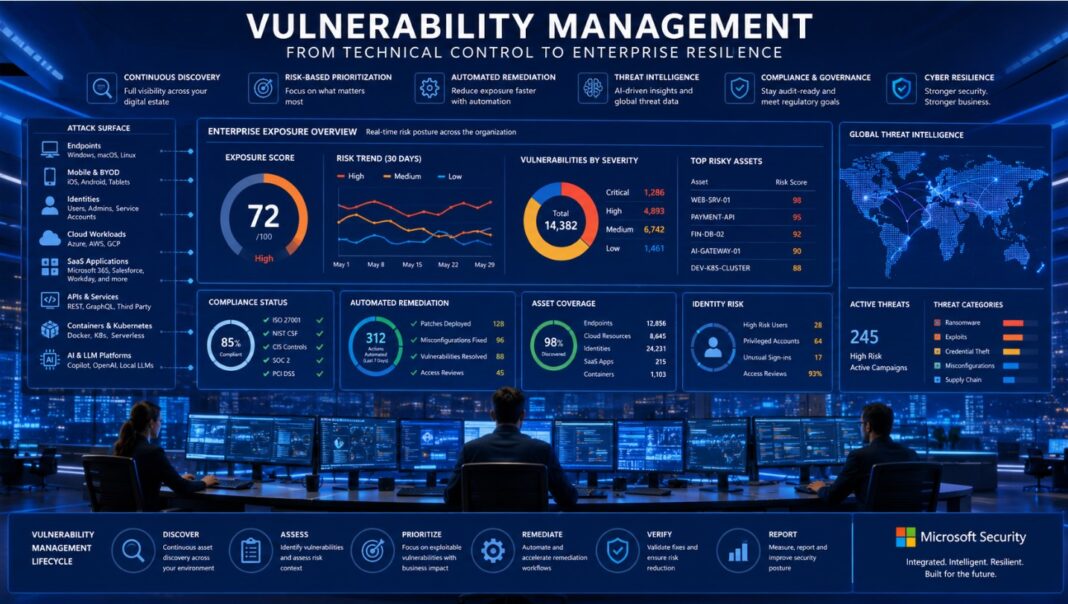
Why Modern Vulnerability Management Matters More Than Ever
Cybersecurity has entered a new era.
Organizations are accelerating digital transformation initiatives, adopting hybrid work models, migrating workloads to the cloud, embracing AI-powered solutions, and enabling employees to work from virtually anywhere. While these initiatives improve agility and business productivity, they also expand the enterprise attack surface at an unprecedented pace.
A decade ago, vulnerability management primarily focused on identifying missing operating system patches and outdated software versions on corporate desktops and servers. Today, security leaders must manage risk across endpoints, identities, cloud workloads, SaaS applications, mobile devices, browser extensions, software supply chains, containers, APIs, and emerging AI platforms.
The challenge is no longer finding vulnerabilities.
The challenge is understanding which vulnerabilities matter most, assigning ownership, automating remediation, and reducing exposure before attackers can exploit weaknesses.
As a result, Vulnerability Management has evolved from a technical security function into a strategic business capability that directly supports cyber resilience, regulatory compliance, operational efficiency, and secure digital transformation.
Executive Summary
Modern enterprises face increasing cyber risk driven by:
- Hybrid and remote work
- BYOD adoption
- Cloud transformation
- AI and Generative AI platforms
- Software supply chain dependencies
- Expanding regulatory requirements
Traditional vulnerability management approaches that focus solely on scanning and reporting are no longer sufficient.
Organizations must move toward an integrated vulnerability management strategy that combines:
- Continuous asset discovery
- Risk-based prioritization
- Automated remediation
- Identity-aware security controls
- Cloud security posture management
- Executive-level risk reporting
This article explores the challenges organizations face today, lessons learned from real-world enterprise discussions, and how Microsoft’s integrated security ecosystem helps organizations build a mature vulnerability management program.
Why This Matters
The scale and speed of cyber risk continue to grow across modern enterprises:
- More than 60% of successful breaches involve unpatched vulnerabilities, misconfigurations, or known security weaknesses.
- Large enterprises routinely manage thousands of vulnerabilities across endpoints, servers, cloud workloads, applications, and identities every month.
- Attack surfaces continue to expand as organizations adopt cloud services, SaaS platforms, remote work models, mobile devices, APIs, and AI-powered solutions.
- Security teams that prioritize risk-based remediation and automation consistently achieve faster response times, lower exposure scores, and improved compliance outcomes.
These trends demonstrate why vulnerability management can no longer be viewed as a periodic scanning activity. It must become a continuous, integrated business process focused on reducing exposure and improving cyber resilience.
The New Enterprise Attack Surface
Modern enterprises rarely operate within a single network perimeter.
Today’s digital environments include:
- Corporate-owned Windows devices
- macOS endpoints
- Mobile devices and BYOD programs
- Hybrid and remote workers
- Azure, AWS, and GCP workloads
- SaaS applications
- Containers and Kubernetes environments
- Third-party software dependencies
- AI platforms and local LLM deployments
Each of these environments introduces potential vulnerabilities that must be continuously monitored, assessed, and remediated.
As organizations grow, security teams often discover that visibility becomes fragmented across multiple tools and operational teams. The result is increased complexity, reduced efficiency, and greater cyber risk.
Enterprise Attack Surface Layered Architecture
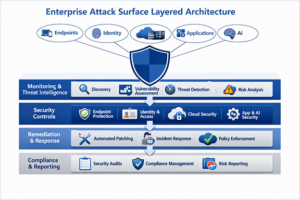
The modern attack surface extends far beyond traditional endpoints. Security leaders must now manage risk across identities, cloud resources, applications, APIs, and AI ecosystems while maintaining a unified view of enterprise exposure.
Five Challenges Every Enterprise Faces
- Tool Sprawl
Most organizations have accumulated numerous security and management platforms over time.
Common examples include:
- Endpoint management solutions
- Vulnerability scanners
- SIEM platforms
- Cloud security tools
- Identity management systems
- IT service management platforms
While each platform delivers value independently, they frequently operate in silos.
This often results in:
- Duplicate vulnerability findings
- Conflicting reports
- Increased operational effort
- Delayed remediation
- Reduced visibility
The challenge is rarely a lack of security tools.
The challenge is a lack of integration and operational alignment.
Traditional Security Silo vs Unified Vulnerability Management
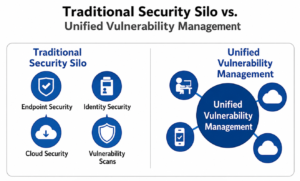
Organizations that consolidate visibility and workflows across security operations, endpoint management, cloud security, and identity governance consistently achieve better outcomes and lower operational costs.
- Patch Fatigue and Remediation Overload
Security teams are overwhelmed by the volume of vulnerabilities discovered across enterprise environments.
A typical enterprise may encounter:
- Thousands of vulnerabilities each month
- Hundreds of critical findings
- Continuous software updates
- Limited remediation windows
- Resource constraints
Without effective prioritization, teams often spend significant effort addressing low-risk vulnerabilities while critical exposures remain unresolved.
Successful organizations prioritize risk rather than volume.
The objective is not to patch everything immediately.
The objective is to remediate what matters most to the business.
- Compliance and Audit Pressure
Regulatory and compliance requirements continue to expand across industries.
Frameworks such as:
- GDPR
- ISO 27001
- NIST
- PCI-DSS
- HIPAA
- CIS Controls
require organizations to demonstrate continuous vulnerability assessment and remediation.
Without centralized visibility and reporting, compliance activities become expensive, time-consuming, and difficult to sustain.
Modern vulnerability management programs play a critical role in supporting audit readiness and regulatory compliance.
- BYOD and Hybrid Workforce Risks
The rise of hybrid work has fundamentally changed enterprise security.
Employees now access business applications from:
- Personal devices
- Home networks
- Shared workspaces
- Mobile phones
- Remote locations
Common risks include:
- Unpatched devices
- Shadow IT
- Unauthorized applications
- Browser extension abuse
- Weak security configurations
Traditional security models were never designed for this level of distributed access.
Organizations must adopt identity-driven and device-aware security strategies to manage modern workforce risks effectively.
- Cloud Misconfigurations
Many organizations still assume malware represents their greatest cybersecurity risk.
In reality, cloud misconfigurations often create more significant exposure.
Examples include:
- Excessive permissions
- Publicly accessible storage
- Misconfigured cloud services
- Weak identity controls
- Exposed APIs
As cloud adoption increases, security posture management becomes equally important as vulnerability management.
Why Vulnerability Management Must Evolve
The modern vulnerability lifecycle includes:

Modern Vulnerability Lifecycle
Traditional vulnerability programs focused primarily on discovery and reporting.
The process often looked like this:

While this approach provided visibility, it did not necessarily reduce risk.
Modern organizations require a continuous risk reduction model.
This shift moves organizations from vulnerability awareness to measurable risk reduction.
Organizations that successfully mature their programs consistently achieve:
- Faster remediation times
- Lower exposure scores
- Improved compliance posture
- Reduced operational costs
- Better executive visibility
Microsoft’s Integrated Security Approach
Microsoft provides a comprehensive ecosystem designed to address modern vulnerability management challenges.
Rather than relying on disconnected tools, organizations can leverage a unified platform that combines visibility, remediation, identity security, endpoint protection, and cloud security.
Microsoft Vulnerability Management Architecture
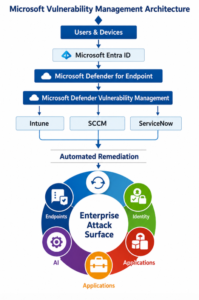
This architecture enables organizations to move from reactive vulnerability management to proactive exposure reduction.
Microsoft Defender Vulnerability Management
Microsoft Defender Vulnerability Management provides continuous visibility into enterprise assets and vulnerabilities.
Key capabilities include:
Continuous Asset Discovery
Automatically identifies:
- Operating systems
- Applications
- Browser extensions
- Software components
- Exposed services
Vulnerability Assessment
Provides:
- CVE visibility
- Exposure scoring
- Threat intelligence context
- Exploitability indicators
Prioritized Recommendations
Security recommendations are prioritized using:
- Business impact
- Threat intelligence
- Device exposure
- Organizational risk
This enables security teams to focus on vulnerabilities that present the highest risk.
Microsoft Defender for Endpoint
Many organizations struggle with visibility across thousands of devices.
Microsoft Defender for Endpoint provides:
- Endpoint telemetry
- Threat detection
- Attack surface reduction
- Vulnerability discovery
Business Outcome
- Reduced attack surface
- Faster threat detection
- Improved endpoint visibility
- Better security operations efficiency
Microsoft Intune
Microsoft Intune enables:
- Device compliance
- Configuration management
- Application deployment
- Patch management
Business Outcome
Automated remediation across corporate-owned and BYOD devices while reducing manual operational effort.
Microsoft Entra ID
Identity has become the new security perimeter.
Microsoft Entra ID provides:
- Conditional Access
- Identity Protection
- Multi-Factor Authentication
- Zero Trust enforcement
Business Outcome
Only trusted users and compliant devices gain access to corporate resources.
Microsoft Defender for Cloud
Organizations increasingly operate across multiple cloud platforms.
Microsoft Defender for Cloud provides:
- Security posture management
- Multi-cloud visibility
- Workload protection
- Container security
Business Outcome
Reduced cloud misconfigurations and improved compliance posture.
Lessons from Real Enterprise Discussions
Recent enterprise discussions reveal several recurring themes that security leaders should understand.
Visibility Must Be Reliable
Organizations reported challenges involving:
- Missing Secure Score data
- Reporting inconsistencies
- Delayed security posture visibility
What We Learned
Security posture should never rely on a single metric.
Organizations should combine:
- Secure Score
- Exposure Score
- Compliance Score
- Patch Compliance
- Executive Dashboards
to create a comprehensive view of organizational risk.
Asset Accuracy Drives Better Decisions
Several organizations reported inconsistencies between device inventories and vulnerability reporting.
What We Learned
If assets are not accurately classified:
- Risk assessments become unreliable
- Remediation efforts become inefficient
- Compliance reporting loses credibility
Asset governance remains the foundation of successful vulnerability management.
Software Supply Chain Risk Is Increasing
Modern applications depend heavily on third-party software components.
Examples include:
- OpenSSL
- Log4j
- Apache Libraries
- Embedded Frameworks
What We Learned
Organizations should establish:
- Application ownership mapping
- Dependency tracking
- ServiceNow integration workflows
- Risk-based remediation processes
to effectively manage software supply chain vulnerabilities.
Browser Extensions Are an Emerging Attack Surface
Browser extensions often receive limited security oversight despite presenting significant risk.
Potential threats include:
- Credential theft
- Data leakage
- Unauthorized access
- Shadow IT
What We Learned
Continuous monitoring and governance of browser extensions should become a standard component of modern vulnerability management programs.
AI Introduces New Security Challenges
The rapid adoption of AI platforms introduces entirely new categories of software risk.
Examples include:
- Local LLM deployments
- AI agents
- AI development frameworks
- Generative AI platforms
What We Learned
Organizations must extend vulnerability management programs to include:
- AI asset discovery
- AI software inventory
- AI risk assessments
- AI governance frameworks
Security teams that ignore AI security today may face significant exposure tomorrow.
Building a Modern Vulnerability Management Program
Successful organizations typically follow four strategic principles.
Build a Unified Operating Model
Integrate:
- Vulnerability discovery
- Asset inventory
- Patch management
- Compliance reporting
- IT service management
into a single operational framework.
Prioritize Risk, Not Volume
Focus on:
- Exploitable vulnerabilities
- Internet-facing assets
- Critical business systems
- High-value applications
rather than simply reducing vulnerability counts.
Automate Remediation
Automation should extend across:
- Discovery
- Prioritization
- Patch deployment
- Validation
- Reporting
Reducing manual effort improves both efficiency and security outcomes.
Align Security with Business Objectives
Security programs should be measured using business-focused metrics rather than technical activity alone.
Measuring Vulnerability Management Maturity
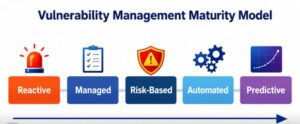
Organizations typically evolve through five stages of maturity.
Vulnerability Management Maturity Model
Level 1 – Reactive Responding to vulnerabilities only after they are discovered.
Level 2 – Managed Regular scanning and patching processes are established.
Level 3 – Risk-Based Business context and threat intelligence drive prioritization decisions.
Level 4 – Automated Integrated remediation workflows reduce manual effort and accelerate response.
Level 5 – Predictive Advanced analytics, automation, and AI continuously optimize security posture.
The goal is not to achieve perfection.
The goal is continuous improvement and measurable risk reduction.
Metrics That Matter to Executives
Successful vulnerability management programs focus on measurable business outcomes.
Key metrics include:
- Mean Time to Remediate (MTTR)
- Exposure Score Reduction
- Secure Score Improvement
- Compliance Score
- Critical Vulnerability Reduction
- Patch Compliance Rate
- Audit Readiness
- Operational Cost Savings
Executive stakeholders care about risk reduction, resilience, and business continuity—not simply the number of vulnerabilities identified.
Strategic Recommendations for CIOs and CISOs
- Consolidate security tooling where possible.
- Adopt risk-based prioritization instead of vulnerability counting.
- Integrate security operations and IT operations.
- Automate remediation workflows.
- Extend governance to cloud and AI platforms.
- Measure security using business outcomes and executive KPIs.
- Continuously mature vulnerability management capabilities.
Final Thoughts
Vulnerability Management is no longer a standalone security activity.
It has become a foundational capability that enables secure digital transformation, regulatory compliance, operational efficiency, and cyber resilience.
Organizations that successfully integrate Microsoft Defender Vulnerability Management, Defender for Endpoint, Intune, Entra ID, Defender for Cloud, and enterprise remediation processes gain far more than visibility.
They gain the ability to identify risk, prioritize action, automate remediation, and continuously improve their security posture at scale.
The organizations that succeed over the next decade will not be those that discover the most vulnerabilities. They will be the organizations that reduce risk faster than attackers can exploit it.
The future of cybersecurity is not about discovering more vulnerabilities. It is about understanding exposure, automating response, and continuously reducing business risk. Organizations that adopt integrated vulnerability management today will build the cyber resilience needed to compete securely in an AI-driven world.